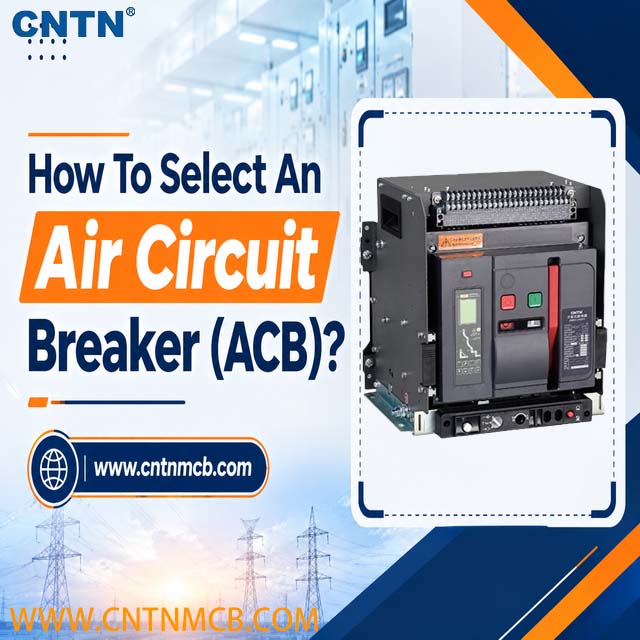
Choosing an قاطع الدائرة الهوائي (ACB) is not just a matter of ensuring that there is compatibility between the ACB’s rating of amperage and the electrical load.
Selection of an ACB can cause failure to give proper fault protection, trip when there is no fault, and can affect coordination of protective devices before and after the breaker.
ACB must also be suitable for use with the switchboard, busbar, cabling, available space, and maintenance.
In these blog, we will provide step-by-step guide of choosing the right ACB using the practical method.
We will also give a detailed guide include rating, voltage, fault current, breaking capacity, number of poles, trip protection, type of construction (draw-out or fixed), accessories, and application considerations.
What Information Do You Need Before Selecting An ACB?
Before getting an ACB quotation, buyers should gather key electrical and installation details.
Supplying complete technical information allows suppliers to suggest the appropriate frame size, trip unit, breaker capacity, and configuration.
Electrical System Parameters
Find the rated system voltage, frequency, number of phases, available fault current, and earthed system.
For instance, the voltage for the system could be 400/415 V, while the frequency would be 50 Hz and will have a three-phase power supply.
Available fault current at the point of ACB installation is of special importance here.
Load and Operating Conditions
Calculate the continuous running current and the peak demand.
The motor, transformer, generator, and other loads having starting or inrush current should be noted.
Expansion in the future needs to be taken into consideration while selecting an ACB.
Installation Requirements
Ensure that ACB installation will be made in the main switchboard, distribution panel, generator panel, or any other panel assembly.
Determine the type of installation to be used (fixed/draw-out), and determine the space available for installation.
The installation connection method (cable/busbar) and environmental conditions must be verified as well.
8 Key Factors For Selecting An Air Circuit Breaker
There are many factors before choosing the right ACB. But we will main technical factors need to be taken into account when choosing an ACB.
1. Determine the Required Rated Current
First, figure out the largest continuous current that the ACB needs to handle during regular operation.
The ACB rating is the maximum current capacity of the breaker itself, whereas the settings dictate how it will be protected.
It should allow for the design plus some engineering margin. Do not oversize it too much since the breaker will need to protect the connected equipment.
2. Confirm the System Voltage and Frequency
It is necessary to compare the rated working voltage of the ACB with the voltage of the distribution system.
The breaker has to meet the insulation characteristics that are required for the particular installation.
In addition, it is necessary to check the frequency, for example 50 or 60 Hz, since the ACB has to be suitable for the particular system.
3. Calculate the Prospective Short-Circuit Current
The fault current present at the installation point of the ACB needs to be determined.
This quantity can be affected by the utility supply, transformer impedance and rating, generator, conductor impedance, and many other electrical system parameters.
The fault current should be computed or determined from an appropriate electrical system study instead of being estimated on the basis of normal load current.
4. Select the Required Breaking Capacity
The ability to safely interrupt the prospective fault current is essential for the ACB.
Important ratings are Icu – the ultimate breaking capacity and Ics – the service breaking capacity.
Selection of the breaking capacity must take into account the applicable fault level and provide adequate margin, if necessary.
If the breaking capacity is insufficient, interruption of a serious short circuit may not be safe and may damage the switchboard and its accessories.
5. Choose the Number of Poles
Three-pole ACB units find use in three phase systems when switching of all three phase conductors is necessary but no switching of neutral is needed.
Four-pole ACB units add another pole for neutral and can be considered when there is a requirement of switching or isolation of neutral in the system.
The choice should be based on earthing scheme and neutral requirements.
6. Select the Appropriate Trip Unit
Current automatic circuit breakers normally employ electronic trip units with configurable protection functions.
Configurable functions may comprise long time, short time, instantaneous, and earth fault protection and may be denoted as L-S-I-G.
Configurable settings help coordinate the breaker with the subsequent protection elements and the protected loads.
Required functions shall be configured based on the load, faults, coordination study, and the protection concept of the electrical system.
7. Decide Between Fixed and Draw-Out Construction
Fixed ACBs are permanently installed in their operating positions and have the advantage of providing simple installations when withdrawal is not needed frequently.
Draw-out ACBs may be withdrawn from the switchboard for various purposes including isolation, testing, and repair. Draw-out construction is recommended if the need exists for any of the above purposes.
The panel and space available will determine the construction type chosen.
8. Identify Required Accessories and Control Functions
Identify whether the installation needs shunt trip, under voltage release, closing coil, motorized operating mechanism, auxiliary contacts, or alarm contacts.
These accessories perform remote trip, electric closure, breaker status indication, and fault indication.
For automatic and digital monitoring systems, communication functions are needed as well.
The accessories should be chosen considering actual control, safety, automation, and maintenance needs instead of unnecessary installation.
How to Calculate the Correct ACB Current Rating?
Choosing the appropriate current rating begins with the electrical load and moves on to other factors like operation and future considerations.
Step 1: Determine the Connected Load
List out the apparatus provided by ACB and find out their power ratings.
The apparatus include motors, lighting, heating load, transformer, and other loads that run together.
Step 2: Calculate the Full-Load Current
For a balanced three-phase system, a basic current calculation is:
I = P / (√3 × V × PF)
Here, I represents current, P represents power, V represents line-to-line voltage, and ف ف represents power factor.
Step 3: Consider Continuous Loads
These loads should be analyzed based on design requirements and operating conditions.
The ACB ratings and its trips should offer adequate protection without causing unnecessary trips when operating under the continuous load requirements.
Step 4: Allow for Future Expansion
Think about the realistic future load growth, equipment, or capacity addition. Do not include an unnecessary margin just to get a larger breaker.
Step 5: Select the Nearest Suitable ACB Rating
Compare your calculated design current with ACB ratings.
Choose the appropriate standard rating based on cable/busbar ratings, installation deratings, protection settings, and other factors.
ACB Breaking Capacity And Short-Circuit Protection
The relationship can be summarized as:
Available fault current → ACB breaking capacity → Protection reliability
The level of fault current indicates the extent of the short circuit that can occur at the location of installation. The short-circuit capacity of the ACB should then match this fault current.
What Is Icu?
Icu, or the ultimate short circuit breaking capacity, is the highest possible short circuit current that an ACB is manufactured to interrupt under certain conditions.
It is crucial in assessing whether the breaker can cope with the prospective short circuit current in the installation.
The ACB’s relevant Icu value must be able to meet the fault level where it will be installed.
What Is Ics?
Ics, that is, service short circuit breaking capacity, is an indication of short circuit performance characteristic in respect to the performance level that is attained following the test.
In critical applications, Ics should be used along with Icu and not just Icu.
What Is Icw?
Icw, or short-time withstand current, indicates the current that the ACB can withstand for a specified short duration under defined conditions.
It is particularly relevant to systems where short-time delay is used for coordination between protective devices.
| المعلمة | المعنى | لماذا هذا مهم؟ |
|---|---|---|
وحدة العناية المركزة |
Ultimate breaking capacity |
Maximum fault interruption |
Ics |
Service breaking capacity |
Continued service after fault interruption |
Icw |
Short-time withstand current |
Short-duration fault withstand |
Icm |
Making capacity |
Fault-closing capability |
How to Select ACB Trip Protection Settings?
The setting for trips is an important aspect of choosing an ACB because the circuit breaker should react to the abnormal currents properly.
Long-Time Protection
The long-time operation is used for dealing with the case of long-term overload.
The value must be equal to the value of continuous loading and the current carrying capacity of the conductor.
Short-Time Protection
Short-time protection operates due to increased fault currents for some time duration.
Short-time time delay and current pickup must be coordinated with other protective devices in the circuit downstream to maintain selectivity.
Instantaneous Protection
Instantaneous protection aims at breaking high fault current quickly.
The value of pickup should be set properly such that it trips due to short circuits and does not trip due to permissible transients.
Ground-Fault Protection
The ground fault protection identifies specified current conditions resulting from ground faults.
It can apply specifically to larger distribution networks.
The settings shall be set based on system design, equipment needs, and the required protection study.
Fixed vs Draw-Out ACB: Which Configuration Fits Your Application?
Both fixed and draw-out ACBs can be suitable depending on the installation’s operational and maintenance requirements.
| الميزة | Fixed ACB | Draw-Out ACB |
|---|---|---|
التركيب |
Permanent |
Withdrawable |
الصيانة |
More involved |
Easier isolation |
الاستبدال |
More downtime |
Faster replacement |
Panel requirements |
Simpler |
More complex |
Typical use |
Standard distribution |
Critical/maintainable systems |
A permanently mounted ACB is suitable for normal distribution applications in which there is no frequent removal of the breaker from service.
A removable configuration can be used in installations that require inspections, testing, replacements, and isolation of maintenance.
Consequently, the decision for selecting any of the two methods should be made taking into consideration various factors such as maintenance philosophy, type of panel, criticality of the system, and space availability.
How ACB Ratings Should Match The Electrical System?
ACB selection should be treated as a connected engineering process:
System voltage → Load current → Fault current → Breaking capacity → Protection settings → Installation configuration
ACB for Main Distribution Boards
Main distribution ACBs generally accommodate large fractions of the building’s electrical loads. Factors to be considered during selection include design current, fault level, coordination with feeders’ breakers, poles, and adjustable electronic trip capability.
ACB for Transformer Protection
The aspects to consider while selecting an ACB for transformer applications include rated current of the transformer, voltage, impedance, inrush current, and fault levels at secondary.
ACB for Generator Applications
Generator ACB settings have to take into consideration generator rated current, fault contribution, voltage, frequency, and generator protection coordination.
These may have to be set according to generator short circuit capability and not utility fault levels.
ACB Selection Example For An Industrial Power System
Let’s assume that there is an industrial plant which uses a three phase 400/415 volt distribution system. The current load will be 800 A while the calculated short circuit current will be 50 kA.
Given Electrical Parameters
| المعلمة | Example Requirement |
|---|---|
System |
Three-phase |
الفولتية |
400/415 V |
التردد |
50 Hz |
Load Current |
800 A |
تيار العطل |
50 kA |
الأعمدة |
3P/4P based on system |
التركيب |
Draw-out |
Protection |
L-S-I-G |
Selection Process
Firstly, the ACB should have a proper current rating for the 800 A continuous load.
The frame and trip rating should be selected after considering the busbar, cable, temperature, and the installation environment.
Secondly, make sure that the ACB rating matches that of the 400/415V, 50Hz system.
Then, the available 50kA fault current should be checked against the short-circuit ratings of the breaker.
The chosen ACB should have the applicable Icu which exceeds the fault level of the installation.
The choice between a 3-pole or a 4-pole type should be done considering the neutral connection in the system.
Since it is an industrial system, an L-S-I-G trip unit of electronic nature will offer coordinated protection functions.
Finally, the draw-out construction type should match the switchboard construction type.
ACB Selection For Different Applications
Before buying the right ACB, the buyer must assess its performance according to the required use and check for compatibility with the whole system.
منشآت التصنيع الصناعي
aspects need to be taken into account while selecting ACBs because of the variable nature of the machines used. Electronic trip units are necessary where precise protection is required.
المباني التجارية
The use of ACBs in commercial buildings is common for main distribution and feeders.
It is important to consider the factors of the building load, protection of feeders, fault currents, neutrals, and coordination with other breakers downstream.
مراكز البيانات
Data centers need to consider continuous loadings, redundancy, protection against faults, selectivity, and maintenance.
It may be necessary for ACBs to have sophisticated trip capabilities, communication facilities, and draw-out type when required by the electrical design.
Generator and Power Distribution Systems
Considerations for generators include generator capacity, fault contribution, transient currents, voltages, frequency, and generator protection coordination.
Systems supplied by generators may need to be configured differently from utility-supplied systems since the available fault current may be very different.
Common ACB Selection Mistakes To Avoid
- Selecting only by ampere rating:Current rating alone does not determine whether the ACB can safely interrupt system faults.
- Ignoring prospective short-circuit current:The installation fault level must be determined before selecting breaking capacity.
- Choosing inadequate breaking capacity:The ACB’s applicable short-circuit rating must match the fault level.
- Matching voltage but ignoring frequency:Voltage and frequency should both be compatible with the application.
- Using incorrect protection settings:Poor settings can cause nuisance trips or inadequate protection.
- Ignoring neutral switching requirements:The number of poles must reflect the actual system configuration.
- Selecting the wrong installation configuration:Fixed and draw-out construction have different panel and maintenance requirements.
- Forgetting future expansion:Planned capacity increases should be considered during initial selection.
- Overlooking breaker coordination:Upstream and downstream devices should operate in a coordinated manner.
- Not checking panel compatibility:Physical dimensions, connections, accessories, and mounting arrangements must match the switchboard.
Final Thought
The selection of an Air Circuit Breaker demands a meticulous assessment of factors such as the current rating, voltage, breaking capacity, protection settings, number of poles, and installation needs.
If an ACB is selected after a proper assessment of its features, it may prove to be an efficient protector of the electrical distribution system.
If you still have questions about ACB selection or circuit protection solutions, feel free to contact سي إن تي إن إلكتريك at fanghuiwen@cntnmcb.com. Our technical team can provide further information about product specifications, configurations, and application requirements.
We aim to provide a professional response within 24 hours.

الأسئلة الشائعة
What is the most important factor when selecting an ACB?
There is no parameter alone that determines the total selection. The existing rating, system voltage, prospective short circuit current, interrupting capacity, protection, layout, and coordination need to be considered together.
How do I determine the correct ACB ampere rating?
Work out the design or full load current by taking into consideration the system voltage, power, power factor, and number of phases. Compare the calculated value against available ACB ratings while considering the cable/busbars capacity.
How does fault current affect ACB selection?
Fault current affects the amount of short circuit current the breaker has to interrupt. Breaking capacity of the ACB, for example Icu, should be sufficient for the prospective fault current at the point of installation.
When is a 4-pole ACB required?
There may be a need for a 4 pole ACB if the system in question is a three-phase system that needs neutral breaking or isolation according to its electrical design.
What is the difference between ACB frame size and trip rating?
Frame size refers to the physical as well as current carrying capacity of the ACB system, and the trip rating refers to the current level at which the trip unit is operated. Both ratings should not be considered equivalent.
What information should I provide to an ACB supplier before requesting a quotation?
Include the following information: System voltage; frequency; phase configuration; load current; fault current; number of poles; breaking rating; tripping functions; fixed or drawout; installation; accessories; and standards/ certifications. This will help the supplier formulate a suitable specification.