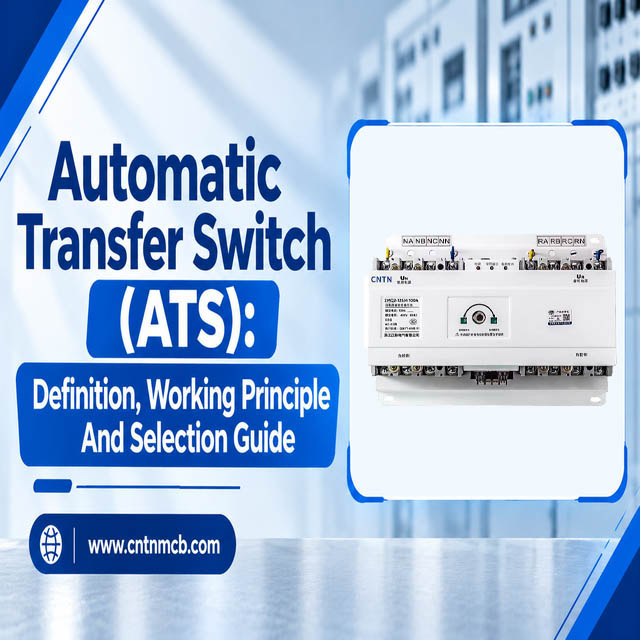
ATS is the abbreviated form of Automatic Transfer Switch.
ATS is a type of switching apparatus used extensively in backup power supply systems.
This apparatus switches electrical loads from one source to another.
In this article, we will discuss Automatic Transfer Switches definition, working principle, and the buying guide when choosing the correct ATS.
Now, let’s delve deepe
What Is An Automatic Transfer Switch (ATS)?


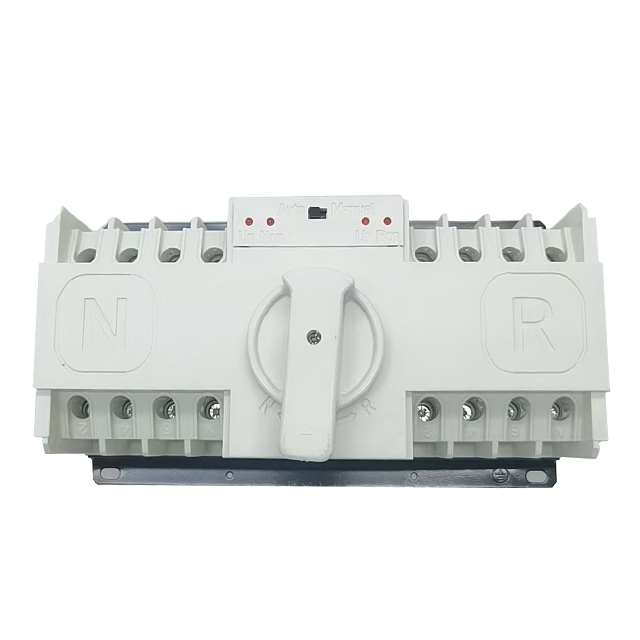
ATS refers to the switching device used in electricity which switches off power from the main supply to another supply in case of failure of the primary power source.
In most cases, an ATS links the primary utility power source to a secondary generator.
Upon any disruption in utility power or an irregularity, the ATS moves the load to the secondary power source.
Automatic Transfer Switches are extensively used in office buildings, industrial complexes, hospitals, and other places where uninterrupted power supply is vital.
In the next part, the working principle of an Automatic Transfer Switch will be explained in detail.
How Does An Automatic Transfer Switch Work?
The basic ATS process typically involves a few stages: monitoring of main power → power failure → signal for generator starting → backup power confirmation → load transfer → restore of main power → return transfer.
Let us consider each phase in detail.
1. Main power monitoring
The Automatic Transfer Switch, under standard working conditions, constantly monitors the primary source of power.
This includes checking various electrical parameters such as voltage and frequency.
So long as the main electrical source is stable and within the accepted range, then the ATS ensures that the electrical load stays connected to the main source.
2. Power failure detection
In the event that the utility power goes off or the voltage level falls below the required range, the ATS identifies the problem.
Some ATS systems have a small period of delay before transferring to the standby source. This ensures that no switching occurs in case of fluctuations in power supply.
3. Generator start signal
After ensuring that the primary power source has failed, the ATS generates a signal that initiates the backup generator.
Afterwards, the generator starts to run and generates electricity.
Nevertheless, the ATS will not switch the load right away since the alternate source of power must become stabilized.
4. Backup power verification
When the generator begins to operate, the ATS checks the backup power source for stability in terms of its voltage and frequency.
Following the verification of the power output capability of the generator, the Automatic Transfer Switch is prepared to switch the load from the main source to the secondary source.
5. Load transfer
The ATS transfers the load off of the primary source of power and onto the alternate generator.
The process takes place automatically without any need for manual intervention. The electric devices can then continue functioning powered by the alternate source.
Differences Between Automatic Transfer Switches And Manual Transfer Switches
Automatic Transfer Switches (ATS) and Manual Transfer Switches (MTS) differ in three main aspects: working principle, type, and application.
| Item | Automatic Transfer Switch (ATS) | Manual Transfer Switch (MTS) |
|---|---|---|
Working Principle |
It automatically detects power failure and shifts the electrical load from the prime power source to the secondary power source. |
Requires an operator to manually switch the electrical load from the main power source to the backup power source. |
Type |
Three common types are available: open-transition, closed-transition, and delayed-transition automatic transfer switches. |
Available in different configurations, including single-phase and three-phase manual transfer switches. |
Applications |
Used in hospitals, data centers, industrial facilities, commercial buildings, and emergency backup power systems. |
Used in residential buildings, small commercial facilities, workshops, and applications where manual power switching is acceptable. |
How To Select The Right Automatic Transfer Switch?
When choosing an Automatic Transfer Switch (ATS), there are various considerations to take into account such as the load, voltage, power supply, and transfers among others.
Next, let us talk 7 main steps before choosing the correct Automatic Transfer Switch.
- Determine the electrical load capacity:Step one is to determine the total electrical load that the ATS will have to cope with. The rated current of the connected equipment must be considered, as well as possible future load additions. The correct ATS must be chosen, for instance, 100A, 200A, or 400A.
- Confirm the voltage and phase requirements: After that, you need to identify if your system is single-phase or three-phase. Some of the popular ATS voltages include 120V, 220V, 380V, and 400V. The chosen ATS should be able to work with the voltage and phase of your primary and secondary power sources.
- Identify the power sources: Find out the sources of electricity to which the ATS will be connected. In most cases, the ATS connects the utility power source with the generator. But sometimes there may be two utility supplies or several generators. Choose an ATS that meets the requirements of your setup.
- Choose the appropriate transfer type:There are three different types of transitions: open transition, closed transition, and delayed transition. Open transition switches disconnect one supply before connecting another and are suitable for most applications. Closed transition switches permit an overlap between two synchronized supplies, whereas delayed transition switches permit a delay between disconnecting and reconnecting.
- Check the generator compatibility: Should you intend to employ an ATS along with a standby generator, ensure that the switch can provide starting and controlling signals for the generator. Furthermore, verify the generator’s output voltage, output frequency, and output rating. It should be able to power the load without exceeding its output rating.
- Consider safety and protection features:Evaluate the short-circuit withstand capacity, electrical insulation, interlock device, and compatibility with circuit breakers and other protective devices in the ATS. These will prevent any hazardous connection between power sources and increase efficiency of the electrical system.
Consider installation and maintenance requirements: Lastly, make sure that the ATS is intended for indoor or outdoor installation. Look at the rating of its enclosure protection, the operating temperature, the space for installation, and the requirements for maintenance. In case of critical installations, you can select the ATS with bypass and isolation capabilities.
Conclusion
In summary, an automatic transfer switch (ATS) helps in switching power from one source to another in case of power failure. It is commonly used in commercial and industrial installations.
If you need high-quality circuit breakers or dependable electrical protection products for your projects, you can contact CNTN Electric for more information and professional support. We will be glad to assist you.