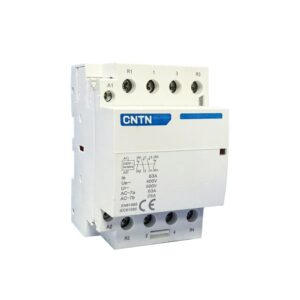
AC Contactor
1.What Is An Alternating Current Contactor ?
As a type of low-voltage switching device, AC contactors use electromagnetic force as their driving core and can control the switching of large currents in the main circuit remotely and frequently using small current signals in the control circuit.
2.What Are The Installation Methods Of Alternating Current Contactor ?
The installation of AC contactors is divided into two types: fixed installation and drawer-type installation.
Before installation, the power must be switched off, and anti-electric shock safety precautions must be strictly followed.
After wiring, the accuracy of the contact wiring sequence should be checked, and the consistency between the coil rated voltage and the control power supply voltage should be confirmed.
After installation, a no-load test run should be performed to observe whether the contactor’s switching action is smooth, and whether there are any abnormal noises or odors.
If any abnormal conditions occur, the power must be immediately cut off to troubleshoot the problem.
3. How Alternating Current Contactor Work ?
The core principle of an AC contactor is using a small current to control a large current.
When alternating current is applied to the contactor’s coil, the coil immediately generates a strong electromagnetic force, attracting the iron core. The iron core then moves the main contacts and auxiliary contacts together to “close” the circuit. At this point, the main circuit is connected, and high-power equipment such as motors and water pumps can operate normally.
Once the power to the coil is cut off, the electromagnetic force disappears, the iron core is returned to its original position by a return spring, and the contacts open, disconnecting the main circuit and stopping the equipment.
4. Applications Of Alternating Current Contantor
The core value of an AC contactor lies in realizing the safe on-off operation of a high-current main circuit through a low-current control circuit.
It is widely applied in scenarios that require starting, stopping, controlling, or protecting high-power electrical equipment, covering multiple fields such as industry, commerce, and civil use.
5. Advantages of AC contactors
AC contactors are the “workhorses” of low-voltage electrical control, and their core function is to control large currents with small currents.
We don’t need to directly handle high-power circuits; instead, we can use small components like buttons and relays in the control circuit to remotely switch on and off large devices such as motors and pumps, significantly reducing the risk of electric shock.
When combined with protective devices like fuses and circuit breakers, the circuit can be immediately disconnected in case of a fault, ensuring the safety of both personnel and equipment.
They are incredibly durable, capable of withstanding millions of frequent starts and stops. They are indispensable for the automated operation of conveyor belts in production lines, pumps and valves in factories, and motors in machine tools.
Working in conjunction with PLCs and sensors, they enable equipment to start and stop automatically and adjust intelligently, saving on labor costs and significantly increasing production efficiency.
Compared to old-fashioned knife switches, AC contactors are “space-saving masters”—small in size and flexible in installation, easily fitting into control cabinets and distribution boxes, making complex wiring neat and tidy.
Their contact status is easily visible, making troubleshooting easier; during maintenance, disconnecting the contactor completely isolates the main circuit, making maintenance quick and safe.
Even more convenient, their specifications, wiring, and dimensions adhere to unified industry standards (such as IEC standards), allowing for direct interchangeability between different brands, saving money on replacements and spare parts.
However, they do have some minor drawbacks: they cannot provide overload protection on their own and must be paired with thermal relays or circuit breakers; otherwise, overload will burn out the contacts; frequent starting and stopping will shorten their lifespan due to arcing at the contacts, requiring regular inspection and replacement; also, after power is cut off, the contacts rely on a spring for reset, and if the spring fails, the contacts will stick together, easily causing circuit malfunctions.
Technical and Business Version:
As a core execution component of low-voltage electrical control systems, the AC contactor’s core advantage lies in its isolation control mechanism, using small currents to control large currents.
Through external devices such as buttons and relays in the control circuit, it can achieve remote switching of high-power main circuits, effectively avoiding the safety hazards of personnel directly contacting high-voltage and high-current circuits; combined with protective devices such as fuses and circuit breakers, it can quickly disconnect the circuit in case of a fault, ensuring stable equipment operation and personnel safety.
This component boasts a mechanical lifespan of millions of cycles, meeting the demands of frequent start-stop operations and serving as a core foundation for the automated operation of equipment such as motors, pumps, valves, and conveyor belts on production lines.
It can seamlessly integrate with industrial control components such as PLCs and sensors to build intelligent control loops, enabling automated start-stop and parameter adjustment of equipment, thereby improving production efficiency and optimizing labor costs.
Compared to traditional knife switches, AC contactors, with their compact structure and flexible installation, can be directly integrated into control cabinets and distribution boxes, significantly simplifying the wiring design and spatial layout of the power distribution circuit; they offer high visibility of contact status, facilitating troubleshooting; during maintenance, disconnecting the contactor reliably isolates the main circuit, greatly improving the safety and efficiency of maintenance operations.
The product specifications, wiring methods, and installation dimensions all comply with industry standards such as IEC, ensuring good brand interchangeability and effectively reducing the overall cost of equipment procurement and spare parts replacement.
It should be noted that AC contactors themselves do not have overload protection functions and must be used in conjunction with thermal relays and circuit breakers; otherwise, overload conditions can easily cause contact burning.
Frequent start-stop cycles will accelerate contact arc wear, requiring regular inspection and replacement. Furthermore, its power-off reset relies on a spring mechanism; spring failure will lead to contact sticking, resulting in circuit failure.
Showing all 2 resultsSorted by latest
100A 4 Pole Contactor ZMB1
AC ContactorHousehold Contactor ZMB2
AC Contactor