
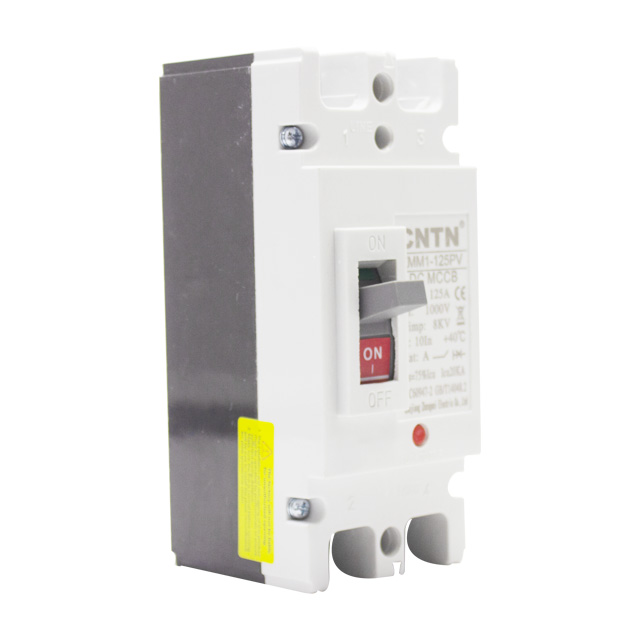
DC Molded Case Circuit Breaker
- Over 10 years of experience in manufacturingDC Molded Case Circuit Breaker(DC MCCB)
- Rapid production and delivery capabilities
- Provide product customization
- 24*7 online service for you
Our reliable products for you
6 benefits you can get from CNTN electric?
Ultra safe
CNTN uses only high-quality materials to DC manufacture miniature circuit breakers, which ensures you use electricity more safely.
Various certifications
Every year, CNTN invests around 1 million RMB in various certifications, including CE, RoHS, ISO9001, and CCC, so you can use our products with confidence.
100% product test
CNTN's miniature circuit breakers undergo 100% testing before leaving the factory. This takes a lot of time, but it's worth it. By doing so, we can ensure your electrical safety.
Factory direct sale
CNTN is a Chinese manufacturer and supplier of miniature circuit breakers (MCBs). We have 30 professional employees ready to serve you.
Flexible MOQ
We accept small trial orders for new markets, as well as bulk orders from established distributors and projects.
Rich export experience
We have extensive experience exporting products to Europe, the Middle East, Southeast Asia and the Americas, so you can completely trust us.
Application Scenarios of DC Miniature Circuit Breakers (MCCB)

Electric vehicles
The working principle of DC MCCBs in new energy vehicles centers on dynamically safeguarding the vehicle’s high-voltage and low-voltage DC circuits. By monitoring current in real time, responding quickly to faults, and cutting off the circuit, it eliminates risks such as fire and equipment damage. Essentially, it serves as the “safety guardian” of the vehicle’s high-voltage system.

Eectroplating Equipment
The working principle of DC MCCBs in electroplating/electrolysis equipment centers on real-time monitoring of DC circuit current. When faults such as overcurrent or short circuit occur in the circuit, it quickly cuts off the circuit to protect equipment and process safety. Essentially, it provides an “overload protection barrier” for a stable DC power supply environment.

Rail Transit
The working principle of DC Molded Case Circuit Breakers (DC MCCBs) in rail transit mainly involves normal switching (closing and opening), overload and short-circuit protection, and arc extinguishing. They are used in scenarios such as the DC traction systems of subways and light rails, or the DC auxiliary power supply circuits inside vehicles, to protect the circuit safety of traction motors and on-board equipment.

Wind Power System

Commercial Building

Aerospace Systems
Where do you want to use our MCBs?
Frequently Asked Questions
What is a DC Molded Case Circuit Breaker?
What is the working principle of a DC Molded Case Circuit Breaker
1. Core Working Logic: Three-Step Fault Protection
Step 1: Current Monitoring
Step 2: Fault Identification
- Overload Fault: When the current exceeds the rated value but does not reach the short-circuit level (e.g., motor stalling), the bimetallic strip bends due to the thermal effect of the current, pushing the mechanical mechanism to trigger tripping.
- Short-Circuit Fault: When the current surges to several times or even dozens of times the rated value (e.g., line short-circuit), the electromagnetic coil generates a strong magnetic field, which attracts the iron core to quickly strike the tripping mechanism, achieving “instantaneous tripping”.
Step 3: Circuit Interruption and Arc Extinguishing
2. Key Designs: Core Differences for Adapting to DC Scenarios
- Arc-Extinguishing System Optimization: To address the difficulty of extinguishing DC arcs, the arc-extinguishing chamber adopts a “multi-grid splitting + strong magnetic field drive” design. This splits long arcs into multiple short arcs, rapidly reducing arc energy and ensuring the circuit is completely de-energized after interruption.
- Tripping Characteristic Adaptation: DC circuits have no current zero-crossing point, and short-circuit current peaks are higher with longer durations. Therefore, electromagnetic trip units have higher sensitivity and faster response speeds, capable of triggering interruption within milliseconds to prevent equipment from enduring excessive inrush current.
Types of DC Molded Case Circuit Breakers (DC MCCB)
- By Tripping Mechanism
- Thermal-Magnetic DC MCCBs: Integrate dual protection of “bimetallic strip (for overload)” and “electromagnetic coil (for short circuit)”. Suitable for general DC scenarios (e.g., industrial auxiliary circuits, small energy storage systems) with simple structure and cost-effectiveness.
- Electronic DC MCCBs: Adopt electronic current sensors and microprocessors for precise current monitoring. Support adjustable protection parameters (e.g., overload trip time, short-circuit current threshold) and are ideal for complex DC systems (e.g., large-scale photovoltaic stations, rail transit traction circuits) requiring flexible protection
- By Breaking Capacity
- Low Breaking Capacity DC MCCBs: Designed for low-current DC circuits (usually ≤ 10kA breaking current), used in household energy storage, communication base station auxiliary circuits, etc.
- High Breaking Capacity DC MCCBs: With breaking current up to 50kA or higher, they withstand large short-circuit energy and are applied in high-power scenarios (e.g., industrial DC drives, ship propulsion systems).
- By Installation and Structural Form
- Fixed DC MCCBs: Fixed on electrical cabinets or distribution boards via screws, with stable installation. Common in stationary DC power systems (e.g., ground traction substations, industrial control cabinets).
- Plug-In DC MCCBs: Can be plugged into matching sockets, enabling quick disassembly for maintenance. Suitable for scenarios requiring frequent device replacement (e.g., modular energy storage cabinets, mobile power supplies).
- By Special Application Adaptability
- Environmentally Resistant DC MCCBs: With enhanced protection (e.g., IP65 dustproof and waterproof, corrosion-resistant materials) for harsh environments like marine (high salt spray), deserts (high dust), or high-altitude areas (low pressure).
- Rail Transit-Specific DC MCCBs: Feature vibration resistance (complying with EN 50155) and wide temperature adaptability (-40℃ to 85℃), used in subway onboard circuits and ground traction power distribution.
- New Energy-Specific DC MCCBs: Optimized for photovoltaic/storage characteristics (e.g., anti-PV array reverse current, compatible with battery charging/discharging fluctuations), applied in PV combiner boxes and energy storage PCS circuits.
The Differences Between AC Circuit Breakers and DC Circuit Breakers
The main difference between AC molded case circuit breakers and DC molded case circuit breakers lies in the type of current they handle.
AC molded case circuit breakers are designed specifically for handling alternating current, while DC molded case circuit breakers are designed for handling direct current and are suitable for specific applications such as solar power, batteries, and traction systems.
The design and internal structure of these two types also differ. AC contactors utilize thermal-magnetic tripping, with a thermal element detecting overcurrent and a magnetic element detecting short circuits.
This dual protection mechanism ensures efficient and reliable operation of the electrical equipment.
DC molded case circuit breakers, on the other hand, generally contain an electronic tripping mechanism.
This mechanism utilizes advanced electronic technology to provide precise overload and short-circuit protection in DC circuits.
Can DC MCCB be used for AC?
AC molded case circuit breakers cannot be used directly in DC circuits. The core reason is that they “cannot extinguish the DC arc,” and their design is fundamentally incompatible with DC operating conditions.
Arc extinction is the biggest challenge: AC has “current zero-crossing points,” while DC does not, and the insulation and breaking capacity are insufficient.
Does DC MCCB trip on high voltage?
The tripping principle of a DC molded case circuit breaker is that it only responds to current, not voltage.
However, abnormally high voltage can indirectly cause it to trip and may also damage the DC circuit breaker.
How many types of MCCB are there?
DC molded case circuit breakers can be classified according to their application into: distribution type DC molded case circuit breakers, motor protection type DC molded case circuit breakers, and earth leakage protection type DC molded case circuit breakers.
According to their breaking capacity level, they can be divided into Type B (standard breaking capacity), Type S (higher breaking capacity), and Type H (high breaking capacity).
By the number of poles, they can be classified into 2-pole, 3-pole, and 4-pole.
According to the installation method, they can be divided into fixed type and draw-out type.
How to install DC MCCB breaker?
Before installing a DC molded case circuit breaker, all DC power sources to the circuit being installed must be disconnected and verified to be de-energized. Installation personnel must take appropriate safety precautions to prevent electric shock.
It is necessary to verify whether the parameters of the DC circuit breaker match the parameters of the DC circuit.
Ensure the installation environment is dry, free from corrosive gases and dust accumulation, and that the ambient temperature is within the product’s specified range.
Based on the required installation method (fixed or drawer-type), select the appropriate mounting bracket. Insert the DC circuit breaker into the mounting slot in the cabinet, or secure it to the mounting plate with bolts.
The product must be installed in a way that ensures the handle is exposed, facilitating easy opening and closing during daily operation.
During installation, the polarity must be clearly identified, and reverse connection is strictly prohibited. Use copper core wires that match the rated current, ensure the wire stripping length is compatible with the terminals, and make sure the connections are secure. Implement arc suppression measures, and select accessories as needed.
After installation, a visual inspection is required to ensure that the wiring is secure, there are no incorrect or missing connections, and the operating handle moves smoothly during opening and closing operations.
Next, we will perform functional testing, including manual opening and closing tests, tripping tests, and accessory function tests.
It is important to note that DC molded case circuit breakers cannot be used in AC circuits. After installation, circuit labels should be attached to facilitate future maintenance.
What certifications do our products have?
CNTN’s DC MCCB are certified with both CCC and CE certificates.
The CCC certificate is the strictest certification in China, guaranteeing the highest level of safety and minimizing the risk of fire and electric shock during use.
If you require other certifications, such as UL, CSA, UKCA, ETL, or RoHS, we can also provide them upon request. Please contact us for more information.
Our certifications
Our partners worldwide



Contact us now to get our latest prices!
We’d love to introduce our company to you! If you’d like to learn more, please leave a message below. We guarantee a personalized and comprehensive response within 24 hours. Don’t hesitate to start your journey to exceptional solutions!