Disjoncteur à boîtier moulé (MCCB) is very significant in the protection of electric circuits against overload and short circuit faults.
Selection of the right MCCB enhances efficiency in operation as well as ensures safety.
But selecting the wrong one will result in insufficient protection of the apparatus, frequent tripping, and higher costs for installation.
There are several factors which should be considered while selecting the correct MCCB.
But buyers should keep in mind this important factors including voltage, load current, prospective short circuit current, environmental conditions and coordination with other protection devices.
Today, our team will give information about MCCB definition, various types of MCCBs, their features, and uses.
In addition, we will also provide detailed information for selecting the right MCCB. Our team is here to provide help to MCCB buyers and electrical contractors.
What Is An MCCB?
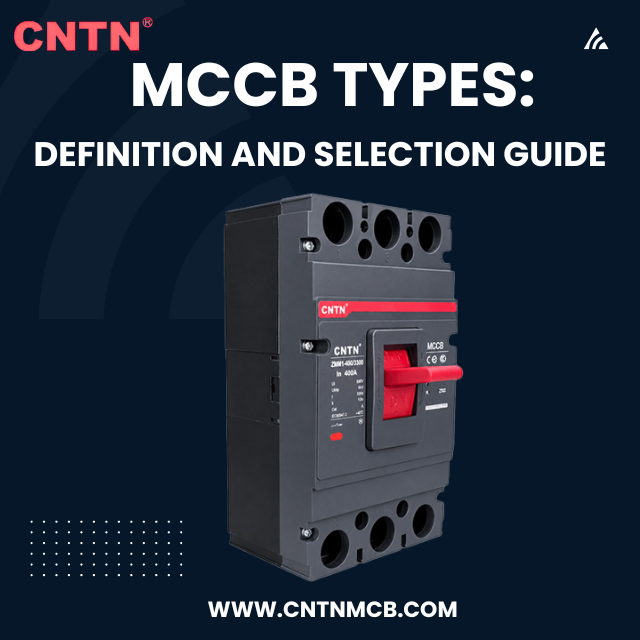
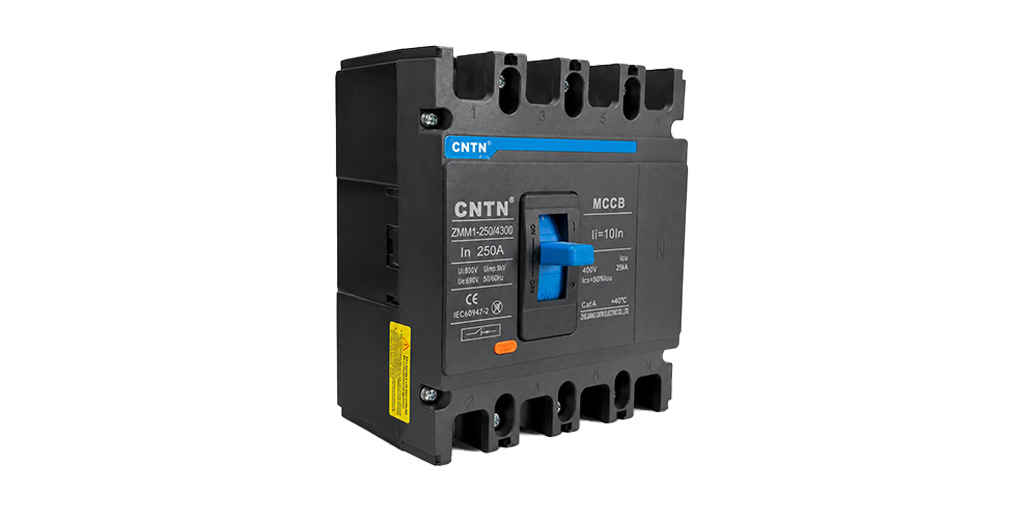
An MCCB stands for Molded Case Circuit Breaker. It is an electrical device whose purpose is to interrupt the flow of current in case there is an overload or a short circuit fault in the circuit.
This type of breaker is enclosed in a molded case.
The breaker has current carrying contacts through which the current passes normally.
A trip device in the breaker senses any abnormal condition and breaks the contacts if there is need for protection.
Based on its design, the trip device can be either of thermal-magnetic type or electronic.
There is also an arc quenching mechanism in the breaker.
This mechanism becomes vital during a short circuit fault where an arc causes a lot of heat as a result of breaking contacts.
Protection provided by the MCCBs is useful in protecting cables, distribution equipment, and loads.
What Are The Main MCCB Types?
Classification of MCCBs is possible on the basis of the operating mechanism, adjustability, number of poles, amperage rating, and application.
Such knowledge aids the purchaser in selecting the right breaker for his/her application.
1. Thermal Magnetic MCCB
Combining both the magnetic and the thermal form of protection, the thermal-magnetic MCCB is designed such that it incorporates both forms of protection in one circuit breaker.
The thermal part normally consists of a bimetallic switch which bends after being heated to trip the circuit breaker due to overheating resulting from an overload current.
Magnetic operation takes place rapidly as a response to fault current to enable separation of the circuit breaker in the event of a short circuit.
Thermomagnetic MCCBs are widely used in commercial distribution panels, machinery circuits, and power distribution.
2. Electronic MCCB
An electronic MCCB operates through electronic sensing and a trip unit that helps in monitoring current and circuit interruption depending on certain conditions.
There is usually a combination of adjustable long time, short time, instantaneous, and ground fault protection features in some types of MCCBs.
Electronic trip units have advantages of increased precision, better monitoring, and coordination capability with other protection devices.
Electronic trip units also have additional features like measurement, alarm, communications, and events.
Electronic MCCBs are used in high voltage installations, especially in big commercial buildings and industries.
3. Fixed Trip MCCB
Fixed MCCBs have preset parameters of protection, either because of the way they have been designed or due to factory settings.
It is possible that, in some cases, the point at which tripping occurs may not be very adjustable.
These breakers are appropriate where the loads are known, and there is no need to coordinate them with other protective devices.
The major disadvantage is inflexibility in terms of changes in the load or different requirements for coordination. Customers should verify the actual settings of the breaker.
4. Adjustable Trip MCCB
Adjustable Trip MCCB is where one can change one or more of its protective parameters within a certain range allowed by the manufacturer of the product.
This would depend on the particular design of the MCCB.
This is a good choice when an engineer needs to set a breaker according to certain load characteristics of the circuit and coordinate it with other protective devices either upstream or downstream of that circuit.
Adjustable Trip MCCB is applied in various applications including industrial distribution and machines.
Nevertheless, the adjustment should not exceed the limits of the manufacturer.
Important distinction
These classifications can overlap.
For example, an MCCB may be electronic, adjustable-trip, three-pole, and designed for a particular current rating simultaneously.
Buyers must consider each category separately because they are not exclusive categories.
MCCB Types Based On Number Of Poles
The number of poles indicates the number of circuit conductors controlled by the MCCB.
The proper arrangement will be selected based on the nature of the electrical power supply, earthing system, and requirements of the neutral.
1-Pole MCCB
1-pole MCCB controls just one conductor and may be appropriate for particular single conductor applications.
These applications are rarer than multi-pole MCCBs in many industrial power distribution systems.
The design engineer is required to ensure that the breaker is capable of meeting all isolation and protection requirements.
One cannot assume that the single pole breaker isolates all conductors of the circuit.
2-Pole MCCB
A 2-pole MCCB switches two conductors and may be used in suitable single-phase systems.
Depending on the system arrangement, these conductors may be line and neutral or two live conductors.
It is important for consumers to ensure that the poles with overcurrent protection are identified, along with whether the neutral pole has been switch-protected.
3-Pole MCCB
A 3-pole MCCB is usually used for three-phase applications.
The three-pole breaker switches three phases and is used for many applications like industry distribution boards, motors, pumps, compressors, and machines.
It should have appropriate ratings for suitable current, voltage, and short-circuit applications.
4-Pole MCCB
The 4-pole MCCB acts on three-phase conductors as well as the neutral conductor.
The 4-pole MCCB is necessary when there is need for neutral switching in the design of the installation.
It will be important to consider the type of the installation as well as the regulations applicable when selecting the four-pole breaker.
Pole Configuration Comparison
| MCCB Type | Nombre de pôles | Application type | Main Feature |
|---|---|---|---|
1-Pole |
1 |
Specific single-conductor circuits |
Single-pole switching |
2-Pole |
2 |
Suitable single-phase systems |
Two-pole control |
3-Pole |
3 |
Distribution triphasée |
Three-phase switching |
4-Pole |
4 |
Three-phase systems requiring neutral switching |
Three phases plus neutral |
MCCB Types Based On Trip Characteristics
Trip Characteristics are used to define how the breaker reacts to various currents.
Trip characteristics help consumers choose the appropriate protection for their cables, motors, transformers, and other electrical devices.
Thermal tripping
The thermal tripping action normally reacts to overloading conditions.
In cases where the current keeps flowing beyond the permissible level, heat is generated, and finally, the tripping action is activated.
Magnetic tripping
Magnetic tripping responds rapidly when current reaches a high threshold, such as during a short circuit. The exact pickup level depends on the breaker design and its specifications.
Electronic trip units
Electronic trip units electronically monitor current, with the ability to set protection parameters.
According to the type of electronic trip unit, there may be various functions including adjustable time delay and instantaneous tripping.
Fixed and adjustable trip
Fixed and adjustable trips describe how protection settings are configured rather than separate sensing technologies.
A fixed-trip thermal-magnetic MCCB and an adjustable electronic MCCB are examples of different combinations.
Trip Characteristics Comparison
In choosing an MCCB, customers are advised to look at the true trip characteristic, pickup, and time delay of the device.
The category alone is not an indication of the coordination capability with other protection devices.
| Type de voyage | Fonction principale | Response or Setting | Suitable For |
|---|---|---|---|
Thermal |
Protection contre les surcharges |
Time-delayed response |
Sustained overloads |
Magnétique |
High-current fault protection |
Rapid response |
Short-circuit faults |
Électronique |
Configurable protection |
Settings depend on trip unit |
Industrial distribution |
Corrigé |
Predetermined protection settings |
Limited adjustment |
Standardized loads |
Réglable |
Flexible protection settings |
User-configured within permitted limits |
Variable loads and coordination |
MCCB Types Based On Current Rating
MCCB comes in different ratings and sizes of frames according to the electrical load.
The rated current denotes the current that the breaker is capable of carrying, while the frame size represents its product size.
These values are related but are not interchangeable. A frame may support several current ratings or trip-unit options, depending on the manufacturer’s product range.
- Lower-current MCCBs may suit smaller distribution circuits and modest loads.
- Medium-current models are often used for commercial distribution, subdistribution panels, and machinery.
- Higher-current MCCBs may be appropriate for main distribution boards, large industrial loads, and substantial power distribution circuits.
No single current range separates these categories since the rating and frame sizes differ among manufacturers and product lines.
When selecting an adjustable type of breaker, the consumer will need to determine the adjustment range of the trip unit.
The frame size alone will not be sufficient basis for choosing a breaker, but rather the ratings of the breaker.
MCCB Breaking Capacity: What Does It Mean?
MCCB breaking capacity refers to the maximum current that can be interrupted by a circuit breaker under particular conditions.
It is perhaps one of the most significant things to consider when choosing a breaker to install in an electrical setup.
Short circuits happen where there is an accidental low resistance that causes the flow of very high currents. Prospective fault current is the current that would flow if a fault happens at a particular location in an electrical setup.
Therefore, buyers must determine the prospective fault current at the installation location and compare it with the breaking capacity of the MCCB.
Icu: Ultimate Short-Circuit Breaking Capacity
Icu is the ultimate short-circuit breaking capacity.
It indicates the short-circuit current level the breaker can interrupt under the specified test conditions.
It does not, by itself, guarantee that the breaker will remain suitable for continued normal service afterward.
Ics: Service Short-Circuit Breaking Capacity
ICS stands for the service short circuit breaking capacity.
This parameter is associated with the capability of the breaker to interrupt the specified current fault and also comply with all post test serviceability requirements.
ICS is normally presented as a percent of Icu; however, the range of values is determined by the specific product and standard applied.
ICS is used to specify the performance after the required tests; however, Icu represents the maximum interruption capability.
Selection Principle
MCCB’s breaking capacity must be suitable for the prospective short-circuit current at the installation point.
Buyers should also review applicable backup protection and coordination requirements.
MCCB Ratings: What Specifications Should Buyers Check?
Selecting an MCCB requires reviewing several technical specifications, not just the ampere rating.
A breaker with the correct current rating may still be unsuitable if its voltage, breaking capacity, pole configuration, or trip characteristics do not match the installation.
The following table summarizes important specifications buyers should review before purchasing an MCCB.
| Spécifications | What It Means |
|---|---|
Courant nominal |
Current the MCCB is designed to carry under specified conditions |
Tension nominale |
Voltage for which the MCCB is rated for the specified application |
Nombre de pôles |
Number of conductors the breaker is designed to switch |
Icu |
Ultimate short-circuit breaking capacity |
Ics |
Service short-circuit breaking capacity |
Unité de déplacement |
Mechanism that senses faults and initiates tripping |
Fréquence |
Compatible AC system frequency, where applicable |
Frame Size |
MCCB frame or current class within the product range |
Buyer should also look at the trip curve, adjustment range, terminal capacity, mounting system, auxiliary contacts, shunt trips, undervoltage releases, and any other necessary accessories.
For installations involving severe environmental conditions, ambient temperature considerations, effect of enclosures, altitude derating, and installation instructions specific to the manufacturer may also become a factor.
The full technical data sheet is important because even if two MCCBs have nearly identical current capacities, specifications can differ from one series to another.
MCCB Selection Guide: How To Select An MCCB

The selection of appropriate MCCB calls for an analysis of the circuit, faults that might occur, and environmental conditions.
The following process will help to select appropriate MCCBs and check their specifications.
1. Determine the load current
Calculate the expected operating current using the supply voltage, load power, power factor, and efficiency where applicable.
For three-phase loads, use the appropriate three-phase calculation. Consider continuous operation, starting current, conductor ampacity, and applicable electrical design requirements before choosing a rating.
2. Check the system voltage
Check the nominal system voltage and the pole-to-pole voltage during normal operation.
The MCCB should have the appropriate operating voltage rating for its use. Also check the manufacturer’s rating for the AC or DC circuit.
3. Select the number of poles
Choose a suitable two-pole configuration for applicable single-phase systems, a three-pole MCCB for typical three-phase circuits, or a four-pole model where neutral switching is required.
Confirm neutral protection and isolation requirements against the system design and local standards.
4. Determine the short-circuit current
Find the expected fault current from studies or calculations of the power system or from the data source of supply.
Choose a suitable MCCB having sufficient Icu value at that particular voltage level. The Ics values should also be considered.
5. Choose the trip type
Thermal-magnetic MCCBs can suit many standard distribution circuits.
Electronic trip units may be preferable when precise adjustment, time delays, monitoring, or selective coordination is important.
Compare fixed and adjustable options according to the required protection functions.
6. Check the current adjustment range
Regarding an adjustable MCCB, make sure the desired setting is within the allowed range from the manufacturer.
The setting should protect the circuit conductors and equipment; there should be no use of flexibility to allow an improper breaker size.
7. Consider ambient temperature
High temperatures can affect current-carrying performance and trip behavior.
Check manufacturer derating information and consider the temperature inside the panel rather than relying only on the surrounding room temperature.
8. Review installation conditions
Check dimensions of panel enclosure, ventilation, clearance, altitude, moisture, dust, and any other environmental factors.
Ensure that you meet any derating requirements and select the appropriate enclosure or accessories to use.
9. Consider selective coordination
Review the characteristics of upstream and downstream protective devices.
Appropriate coordination can help isolate faults closer to their source and reduce unnecessary shutdowns.
Use manufacturer coordination tables or engineering studies when required.
10. Verify standards and manufacturer data
Verify standards, product certification, accessories, terminal configuration, and installation instructions.
Review the datasheet for the specific model before making your purchase to verify that the selected circuit breaker is appropriate for your application.
MCCB Vs MCB: Which One Should You Choose?
MCCBs and Miniature Circuit Breakers (MCBs) both provide protection against overcurrent conditions, but they are designed for different ranges of applications
The best choice depends on load requirements, fault levels, adjustment needs, and the electrical distribution design.
MCCB vs MCB Comparison
| Fonctionnalité | MCCB | MCB |
|---|---|---|
Current capacity |
Généralement plus élevé |
Généralement plus bas |
Capacité de rupture |
Often higher, model-dependent |
Often lower, model-dependent |
Trip adjustment |
Available on many models |
Usually limited |
Applications |
Commercial and industrial distribution |
Residential and light commercial circuits |
Taille |
Generally larger |
Generally more compact |
Protection flexibility |
Often greater |
Usually simpler |
Coordination options |
Broad options in suitable product ranges |
Depends on the device and system |
Common MCCB Applications
MCCBs are used in many electrical installations because they can provide suitable overload and short-circuit protection across a wide range of current ratings and system configurations.
- Industrial power distribution:MCCBs protect distribution feeders supplying production equipment, workshops, and industrial subpanels. Breaking capacity and coordination are especially important where fault levels are high.
- Commercial buildings:Office buildings, shopping centers, and large facilities use MCCBs in suitable main and sub distribution circuits to protect feeders and electrical equipment.
- Motors and machinery:MCCBs can provide short-circuit and overload protection when properly selected and configured. Motor starting currents and coordination with contactors and overload relays must be considered.
- Generator systems:MCCBs may protect generator outputs or connected distribution circuits. Their ratings must suit generator fault characteristics and the system’s operating arrangement.
- Transformer protection:MCCBs may protect transformer-connected circuits when their ratings and protection characteristics suit transformer inrush current and available fault current.
- Solar power systems:Suitable MCCBs may be used in applicable AC distribution circuits and in specifically rated DC applications. Buyers must verify DC voltage, polarity, interruption ratings, and product suitability.
- Main distribution panels:MCCBs can protect incoming or outgoing feeders and help coordinate distribution circuits.
Common Mistakes When Selecting An MCCB
Even a reputable MCCB can be unsuitable if it does not match the circuit’s requirements. Avoid these common selection mistakes:
- Selecting only by ampere rating:The current rating must suit the load and conductor design, but voltage, trip characteristics, and breaking capacity also matter.
- Ignoring prospective short-circuit current:An MCCB with insufficient breaking capacity may be unable to interrupt the available fault current safely.
- Choosing an incorrect voltage rating:Verify the system voltage and the manufacturer’s rated operational voltage for the intended application.
- Selecting the wrong number of poles:An unsuitable pole arrangement may fail to meet the system’s switching or isolation requirements.
- Ne pas tenir compte des caractéristiques du trajet :The trip curve and settings must protect the circuit without causing inappropriate tripping during normal operating conditions.
- Choosing unsuitable breaking capacity:Check Icu at the applicable voltage and review Ics where continued serviceability after interruption is important.
- Ignoring ambient temperature:High panel temperatures may require derating or a different breaker selection.
- Forgetting selective coordination:Poor coordination can cause an upstream breaker to trip unnecessarily, interrupting more of the installation than needed.
- Choosing only by price:A lower purchase price may not represent the best value if the breaker lacks required ratings, accessories, or protection functions.
- Skipping the technical datasheet:Similar-looking MCCBs can have different ratings and limitations. Verify the exact model before approving a purchase.
MCCB Selection Checklist
This is a practical checklist to use prior to buying your MCCB. It ensures that buyers, assemblers, and electrical contractors ensure all design features have been met in order to avoid buying the wrong item.
- Load current calculated
- System voltage confirmed
- Number of poles selected
- Prospective short-circuit current determined
- Icu and Ics checked
- Trip mechanism selected
- Fixed or adjustable trip confirmed
- Current adjustment range checked
- Ambient temperature and derating considered
- Installation conditions reviewed
- Selective coordination requirements considered
- Applicable standards and certifications verified
- Manufacturer’s technical datasheet reviewed
Réflexions finales
Following a proper selection procedure for MCCB would help the buyers make proper purchase decisions. Below these parameters play an important role in deciding the compatibility of the breaker for the specific circuit.
Apart from choosing an appropriate breaker according to the load current to be supplied, buyers need to look at the trip mechanism, voltage rating, number of poles, current rating, breaking capacity, and environmental conditions.
CNTN Electric provides MCCB solutions for industrial and commercial power distribution applications. Visit our website to explore the available MCCB products and contact the team for product specifications, pricing, and assistance in selecting a suitable circuit breaker for your requirements.