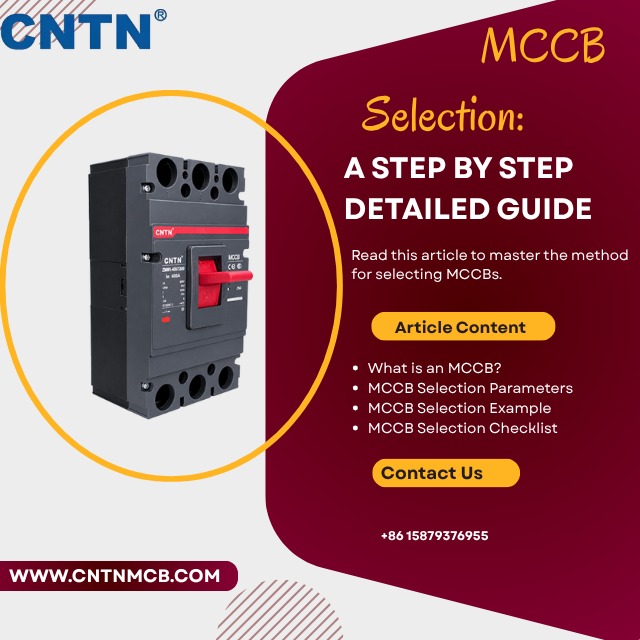
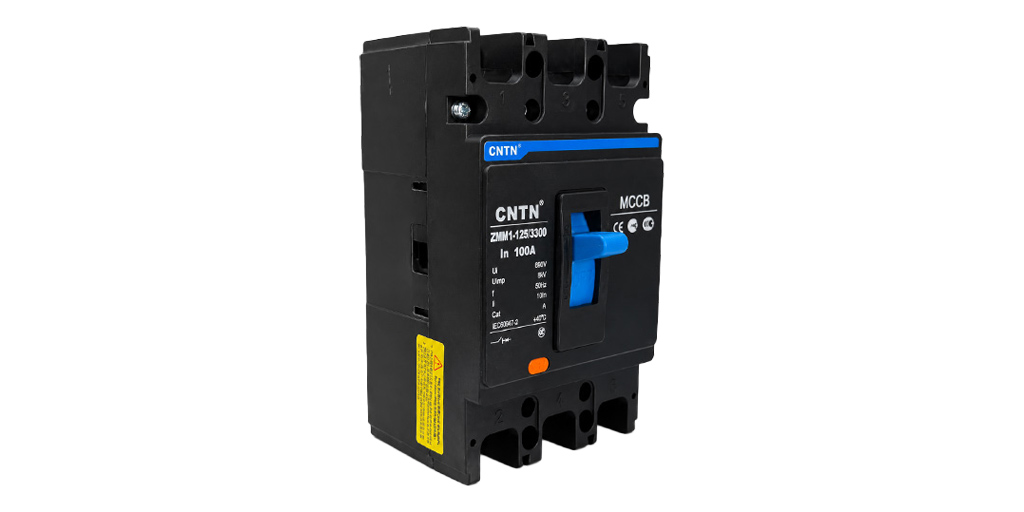
Molded Case Circuit Breakers (MCCBs) are extensively used for protecting electrical distribution systems against overload and short circuit conditions.
MCCBs are used in industrial plants, commercial buildings, distribution boards, machines, and other higher current applications.
Selecting a proper MCCB goes beyond merely matching the breaker’s ampere rating to that of the load.
Other considerations include the load current, system voltage, number of poles, breaking capacity, trip curve, cable size, environmental conditions, and protection coordination.
Today, our team will provides a step-by-step procedure for selecting an MCCB.
It will be useful for engineers, electricians, panel makers, distributors, and buyers who want to choose an MCCB that offers adequate protection without tripping unnecessarily.
What is MCCB Selection?
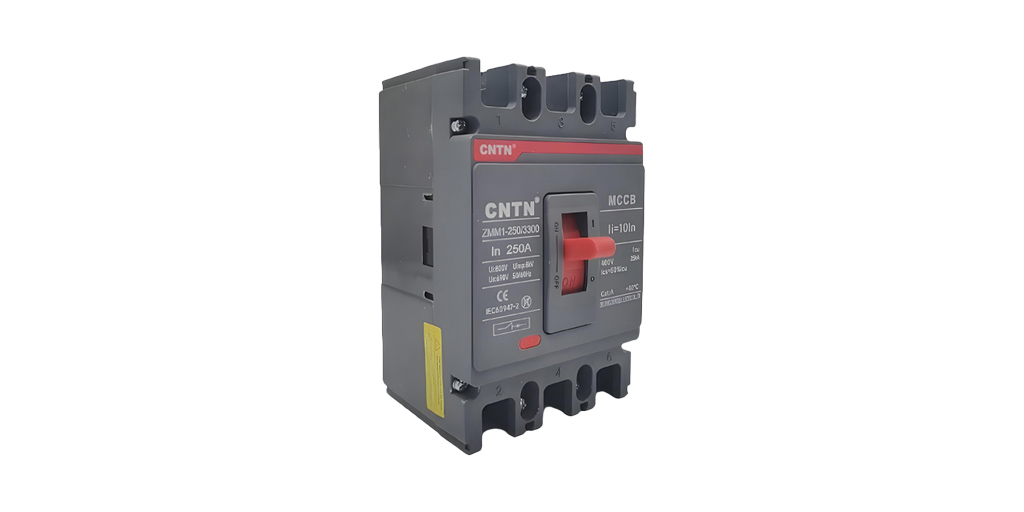
Selection of MCCB entails the process of selecting the molded case circuit breaker based on the electrical, mechanical, and environmental needs of the installation.
The selection criteria include normal load current, voltage, fault level, conductor capacity, tripping characteristic, and protective needs.
Consequently, selecting an MCCB is distinct from the selection of a breaker with appropriate current rating.
This is because an appropriate selection will ensure safe operation under normal and abnormal situations.
Why is Correct MCCB Selection Important?
The proper selection of MCCBs results in efficient overload and short-circuit protection.
This also ensures that the cables, motors, transformers, distribution equipment, and other electrical components are protected from overcurrent.
Improper selection of MCCBs results in frequent tripping, overheating, poor fault interruption, and inefficient system operation.
MCCB Selection Parameters at a Glance
Before selecting an MCCB, identify the major electrical and installation parameters. These factors work together rather than independently.
| Parameter | What You Need to Determine |
|---|---|
Load Current |
Normal operating current |
Rated Current |
Required MCCB ampere rating |
Voltage |
System operating voltage |
Poles |
2P, 3P, or 4P |
Breaking Capacity |
Prospective short-circuit current |
Trip Unit |
Thermal magnetic or electronic |
Trip Settings |
Required protection characteristics |
Cable Size |
Conductor ampacity |
Installation |
Temperature and environment |
Coordination |
Upstream and downstream protection |
Step 1: Calculate the Load Current
Determine the Connected Load
First, determine the total connected load of electricity.
Determine continuous loads and non-continuous loads and also the main equipment like motors, heaters, lighting loads, transformers, and other machinery.
The connected load will act as the basis for computing the load current carried by the MCCB.
It is important to note that the total connected load is not always the real load.
Calculate Full Load Current
For a single-phase load, current can generally be estimated using
I = P / (V × PF)
For a three-phase system:
I = P / (√3 × V × PF)
Where I is current, P is power, V is voltage, and PF is power factor.
In case of resistive loads, the power factor can be near unity. Motor loads need extra attention since their starting current is much higher compared to their regular current consumption.
Consider Future Load Expansion
Do not pick the right MCCB based on today’s load alone if there will be future growth.
But do not go to the extreme either by picking a very large MCCB which may impair overload protection.
Step 2: Determine the Required MCCB Current Rating
Match MCCB Rating With Operating Current
The basic selection sequence is:
Load Current → Required Current Rating → Standard MCCB Rating
For instance, when the computed operating current comes to around 144A, it may be appropriate to use an MCCB with a rated current of 160A, if all the other factors support that option.
Avoid Undersizing
Undersized MCCB can trip too many times when operating normally, causing unnecessary shutdowns, hindering the process and leading to unnecessary maintenance issues.
Avoid Oversizing
If an MCCB is oversized, there will be no proper overload protection of the conductors.
Oversizing of MCCB also decreases protection sensitivity and results in high-level current flowing through the circuit.
Example
In case that the design current is computed to be 144A, the selection of 160A MCCB is preferred over choosing a much higher rated breaker. The decision has to be verified with the ampacity of the cable.
Step 3: Check the System Voltage
Rated Operational Voltage
It is necessary for the MCCB to have the right voltage rating depending on the power system. The voltage rating of the breaker should be equal or higher than the system voltage.
An inappropriate voltage rating of the breaker will pose a safety risk.
AC and DC Applications
AC and DC applications cannot be used interchangeably. Interruption of DC can be more challenging since current does not go to zero automatically, unlike AC, where it goes to zero.
Hence, an MCCB used for DC applications requires correct DC voltage and interrupting ratings as provided by the manufacturer of such MCCB.
Check Insulation and System Requirements
Ensure that you have verified the insulation voltage ratings along with any other criteria required. It is essential to check the specifications on the product literature.
Step 4: Select the Number of Poles
The number of poles will be determined by the system design and whether neutral switching or isolation is needed.
2 Pole MCCB
It is possible to use a 2-pole MCCB for some single phase operations when both the poles need to be switched off or isolated.
3 Pole MCCB
A three-pole MCCB can normally be seen in use where there is a need to switch the three phases and not the neutral.
4 Pole MCCB
In a three-phase plus neutral system where there is a need for neutral switching or isolation, a 4-pole MCCB is applied.
| Pole | Typical Use | Selection Consideration |
|---|---|---|
2P |
Single-phase circuits |
Verify line and neutral requirements |
3P |
Three-phase circuits |
Used where neutral switching is unnecessary |
4P |
Three-phase + neutral |
Used where neutral switching/isolation is required |
Step 5: Determine the Required Breaking Capacity
What Is MCCB Breaking Capacity?
Breaking Capacity is the highest current value that MCCB can safely interrupt under specified conditions.
It is one of the major considerations during MCCB selection since fault currents could be several times higher than working currents.
Determine Prospective Short-Circuit Current
The possible/available short circuit current for the installation point needs to be calculated. The possible/available short circuit current is dependent upon the electrical source, transformer, impedance, conductors, etc.
The interrupting capacity of the MCCB must match the prospective fault current of the installation point.
Icu vs Ics
Icu, or ultimate short-circuit breaking capacity, represents the maximum short-circuit current the breaker can interrupt under specified test conditions.
Ics, or service short-circuit breaking capacity, represents a short-circuit current level associated with the breaker’s ability to continue providing service after specified interruption tests.
Both values should be reviewed when selecting an MCCB, particularly for critical installations.
Why Breaking Capacity Must Not Be Ignored
In case the fault current is higher than the breaking capacity of the circuit breaker, then the MCCB will not be able to interrupt the fault current.
Example
In case the prospective fault making current at the panel is 25 kA, the chosen MCCB must be of a suitable breaking capacity of at least 25 kA under the required conditions. An item having a rating of 36 kA will serve well in such a case.
Step 6: Choose the MCCB Trip Unit
MCCBs generally use thermal magnetic or electronic trip technologies.
Thermal Magnetic Trip Unit
The thermal magnetic devices are used for overload protection through their thermal operation and protection against short circuits through their magnetic operation.
These devices have limited adjustability which makes them less suitable for complicated systems.
Electronic Trip Unit
Electrical trip devices offer more precise control. Depending on the product, they can provide adjustable long-time, short-time, instantaneous, and ground fault protection.
They are especially valuable for industrial distribution systems, where coordination and selectivity are necessary.
| Feature | Thermal Magnetic | Electronic |
|---|---|---|
Overload Protection |
Fixed/limited adjustment |
Highly adjustable |
Short-Circuit Protection |
Magnetic |
Adjustable electronic |
Accuracy |
Standard |
Higher |
Adjustability |
Limited |
Extensive |
Applications |
General |
Advanced systems |
Step 7: Set the Required Trip Characteristics
Long-Time Protection
Protection for extended periods takes into account overloading situations that persist over time.
The settings should consider the normal load and the needs of the protected equipment.
Short-Time Protection
Short time protection works on higher currents which last for some time.
Proper settings can enable coordination with the protection devices below it.
Instantaneous Protection
Instantaneous protection gives quick disconnection for high short-circuit currents.
The correct setting should be chosen such that the MCCB reacts swiftly without causing any unnecessary tripping during transients.
Ground Fault Protection
GFCI can be necessary in a more complicated distribution arrangement where there are particular safety and protection requirements.
These are determined by the design of the distribution system.
Step 8: Match the MCCB With Cable Size
Why Cable Protection Matters
The MCCB needs to not only safeguard the load but also the conductors.
Choosing the breaker without the consideration of the cable will expose the conductors to overcurrent.
Check Cable Ampacity
Ampacity of cables depends on the material of conductor, conductor size, insulation, installation, ambient temperature, and number of loaded conductors.
Hence, the chosen MCCB and its ratings should be able to match the ampacity of the cables.
MCCB and Cable Coordination
MCCBs that are oversized may let currents flow beyond what is safe for the cable before tripping. Protection for the cable, thus, has to be confirmed.
Practical Example
In case a 70mm² copper wire is used in an electrical circuit, the ampacity value should first be computed before determining the rating of the MCCB.
Step 9: Consider Motor Starting and Inrush Current
Normal operational current is not always sufficient for MCCB sizing.
The motors consume multiple times their rated current when starting.
The transformer and capacitors will cause transient inrush currents.
In case the instantaneous or short-time protection is too sensitive, the normal starting currents will trigger tripping.
For applications where the motors drive equipment, pay attention to the starting current and time, motor properties, and MCCB coordination with the motor protection system.
Step 10: Check Installation and Environmental Conditions
Ambient Temperature
High environmental temperature can affect MCCB heat dissipation ability, which may necessitate derating as per manufacturer’s specifications.
Enclosure and Installation
Determine whether MCCB will be mounted within the distribution board, switchboard, control panel, or any other enclosure.
Equipment mounted within the enclosure can have a higher temperature inside than the ambient air.
Altitude
Altitudes above the normal operating conditions of the product may require consultation of the manufacturer’s instructions regarding the thermal properties and insulation of the product.
Humidity, Dust and Corrosive Environments
Dust, moisture, humidity, chemicals, and corrosive environment may affect equipment reliability.
For outdoor applications, harsh industrial environments, the use of proper enclosure and MCCB may be required.
Step 11: Check Protection Coordination and Selectivity
What Is Protection Coordination?
Protection coordination refers to the proper setting of protection systems such that they function correctly when a fault occurs.
MCCB Selectivity
Selectivity seeks to guarantee that the closest protective device to the fault location trips before any upstream devices, when possible.
For instance, the downstream feeder breaker should trip during a feeder fault without tripping the main MCCB.
MCCB With MCB or Other Protective Devices
The master MCCB can supply one or more of the feeder MCCBs that would in turn supply circuits protected by an MCB or other devices.
Why Coordination Matters
Effective coordination avoids any unnecessary power outage and narrows down the extent of the outage in the electrical power system.
Step 12: Consider MCCB Accessories and Additional Features
Selection of accessories should be done on the basis of system requirements.
Auxiliary contacts can provide breaker condition information for control systems.
The alarm contacts are able to indicate the breaker fault condition.
The shunt trip is used for remote electrical operation of the circuit breaker, which may be needed for an emergency shut-down system.
Undervoltage release will trip or prohibit closing at undervoltage conditions.
In automated systems, motor operators allow for remote operating of breakers in open and close positions.
Step 13: Verify Standards and Certifications
Common MCCB Standards
MCCBs usually follow the standard IEC 60947-2 for Low Voltage Circuit-breakers. For molded case circuit breakers in North America, there is the UL 489 requirement.
These requirements can differ based on the location of the project and application.
Why Certifications Matter
Certificates become especially significant when working with international projects, industrial plants, business establishments, government projects, and exporting products.
Remember to check the official data sheets, certificates, and manufacturing requirements rather than just marketing information.
MCCB Selection Example: Complete Step by Step Calculation
Let us now take a three phase distribution network having an operating voltage of 400 volts. Suppose the load connected is 90 kW with power factor 0.9 and prospective short circuit current of 25 kA.
1. Calculate Load Current
For a three-phase system:
I = P / (√3 × V × PF)
I = 90,000 / (1.732 × 400 × 0.9)
I ≈ 144 A
Therefore, the calculated operating current is approximately 144 A.
2. Select Current Rating
A 160A MCCB may be chosen since it is greater than the operating current. However, it should meet certain criteria regarding cable ampacity, derating, and the manufacturer’s specifications.
3. Confirm Voltage
The MCCB must be rated for the 400 V three-phase system.
4. Select Poles
Since the application is a three-phase distribution network, a 3-pole MCCB is suitable when there is no need for neutral switching.
5. Select Breaking Capacity
Short-circuit current prospective = 25 kA. This means that the MCCB selected should have a minimum breaking capacity of 25 kA. The product with an Icu rating greater than 36 kA can be used for additional capacity.
6. Select Trip Unit
Short-circuit current prospective = 25 kA. This means that the MCCB selected should have a minimum breaking capacity of 25 kA.
The product with an Icu rating greater than 36 kA can be used for additional capacity.
7. Check Cable Compatibility
A 70 mm² copper wire can be taken into consideration as an example, but the ampacity of such a wire has to be proven.
Final MCCB Specification
| Parameter | Selected Requirement |
|---|---|
Application |
Three-phase distribution |
Voltage |
400 V |
Load Current |
Approximately 144 A |
MCCB Rating |
160 A |
Poles |
3P |
Breaking Capacity |
≥25 kA; 36 kA example |
Trip Unit |
Electronic, if adjustment is required |
Cable Size |
70 mm² Cu example, subject to verification |
Protection |
Overload + short circuit |
MCCB Selection Mistakes to Avoid
Avoid these common mistakes during MCCB selection:
- Selecting the breaker only by ampere rating.
- Ignoring the prospective short-circuit current.
- Choosing insufficient breaking capacity.
- Oversizing the MCCB unnecessarily.
- Ignoring cable ampacity and installation conditions.
- Using incorrect trip settings.
- Ignoring motor starting or transformer inrush current.
- Failing to coordinate upstream and downstream protection.
- Ignoring temperature, altitude, dust, moisture, or corrosive conditions.
- Failing to verify the manufacturer’s actual technical specifications.
A correct selection should consider the complete electrical system rather than one parameter in isolation.
MCCB Selection Checklist for Engineers and Buyers
Use this checklist before finalizing an MCCB specification.
| Checkpoint | Question |
|---|---|
Load |
What is the maximum operating current? |
Voltage |
What is the system voltage? |
Poles |
How many poles are required? |
Breaking Capacity |
What is the available fault current? |
Trip Unit |
Which protection technology is required? |
Trip Settings |
What settings are needed? |
Cable |
Is the MCCB suitable for the conductor? |
Environment |
Are derating factors required? |
Coordination |
Is the system selectively coordinated? |
Standards |
Which certifications are required? |
How to Choose the Right MCCB for Different Applications?
MCCB Selection for Industrial Machinery
In most cases, industrial machines have high starting currents in motors, compressors, pumps, etc.
When selecting an MCCB, these aspects should be taken into consideration – motor starting, short circuit, cable loading, and adjusting trips.
Electronic trips may prove useful when adjustment and coordination is needed.
MCCB Selection for Commercial Buildings
MCCB is generally used for commercial buildings as main distribution and feeders.
The selection criteria shall include load diversity, feeder currents, cable protection, selectivity, and reliability.
Correct coordination can help avoid the fault in one segment from tripping a major portion of the building.
MCCB Selection for Solar and Renewable Energy Systems
Solar technology demands attention to whether the circuit is an AC or DC circuit. For DC applications, the MCCB requires having appropriate DC voltage and interrupting capacity.
Verification of voltage, faults, environmental exposure, and approved applications by the manufacturer is recommended.
MCCB Selection for Main Distribution Panels
Main distribution boards may need higher current ratings, higher breaking capacity, and advanced electronic trips.
Coordination with the downstream MCCBs and MCBs is very significant since the main breaker influences the reliability of the whole distribution system.
MCCB vs MCB: Which One Should You Select?
MCBs are generally intended for lower-current final circuits, while MCCBs are commonly used for higher-current distribution and industrial applications.
| Feature | MCB | MCCB |
|---|---|---|
Current Range |
Lower |
Higher |
Breaking Capacity |
Generally lower |
Generally higher |
Trip Adjustment |
Limited |
More adjustable |
Applications |
Final circuits |
Distribution and industrial |
Accessories |
Limited |
Extensive |
Protection Settings |
Basic |
Advanced options |
An MCCB is generally more appropriate when the application requires higher current capacity, higher fault interruption capability, adjustable protection, advanced accessories, or detailed coordination.
Questions to Ask Before Buying an MCCB
MCCB Selection for Main Distribution Panels
Before purchasing an MCCB, confirm:
- What is the normal and maximum operating current?
- What is the system voltage?
- What is the prospective short-circuit current?
- What breaking capacity is required?
- How many poles are needed?
- Is a thermal magnetic or electronic trip unit required?
- What trip settings are necessary?
- What cable size and ampacity must be protected?
- Are specific certifications required?
- Are accessories needed for remote operation or monitoring?
Answering these questions before ordering helps prevent incorrect specifications and costly replacement after installation.
Final Thought
The selection of MCCBs is a matter of engineering rather than just choosing a larger current rating.
It has to be compatible with the load, voltage, fault level, cabling capacity, tripping characteristics, environmental conditions, and coordination.
Choosing a good MCCB ensures reliable overload and short circuit protection without frequent trips and downtime of the equipment.
There needs to be a verification of the final selection by engineers or the buyer from the manufacturer’s data and standards.
If you are looking for a reliable and cost-effective MCCB manufacturer from China, or require technical support for your electrical protection project, please send your inquiry or technical requirements to CNTN Electric.
Our team is committed to providing suitable circuit protection solutions for different applications.