Circuit breakers should possess adequate breaking capacity to effectively open any faults.
In case there is a short circuit, the amount of current will become very high compared to its normal value.
Breaking capacity means the ability of a device to interrupt fault current during testing.
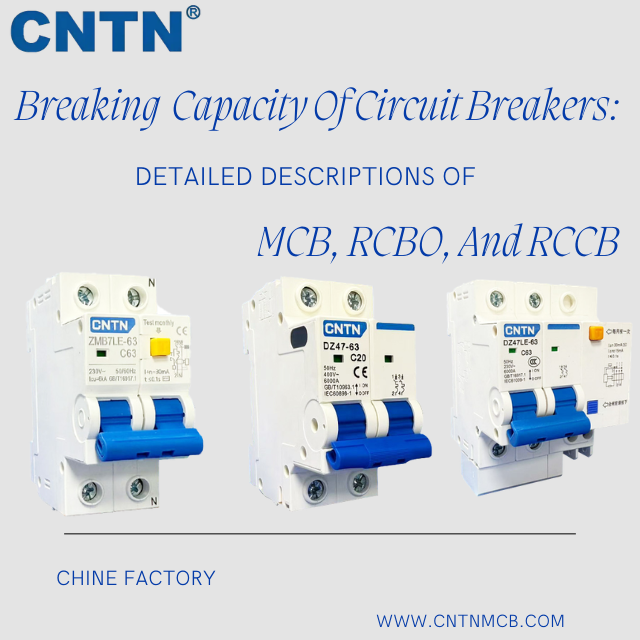
MCBs, RCBOs, and RCCBs offer various means of protection for electrical devices.
MCB offers protection from overload and short circuit. RCBO provides protection from overcurrent and residual currents.
On the other side, RCCB is designed to detect residual currents and earth-leakage currents.
The concept of breaking capacity plays an important role in determining the protection devices needed for electrical contractors, panel manufacturers, distributors, and buyers.
The proper selection will minimize the risk of equipment failure and enhance electrical safety.
What Is The Breaking Capacity Of A Circuit Breaker?
Breaking capacity is the maximum prospective fault current that a circuit breaker can safely interrupt under specified conditions.
It is normally expressed in kiloamperes (kA) and must be suitable for the prospective short circuit current at the installation point.
Meaning of Breaking Capacity
Breaking capacity refers to the capacity of the protective equipment to break down the fault current safely.
In case of a short circuit, there may be very high currents flowing in an extremely short time.
The breaker should be able to open the contacts and extinguish the electric arc without sustaining any significant damage.
Relationship With Short Circuit Current
The prospective short circuit current is the current that may flow in case there is a short circuit in a certain location within the electrical installation.
For instance, if the prospective short circuit current for a distribution board is 5 kA, then it will be necessary to select a protective device having a sufficient rated short circuit breaking capacity.
Why Is Breaking Capacity Measured in kA?
The fault current can be substantially larger than the circuit current under normal working conditions. That is why breaking capacity is stated in kiloamperes (kA).
The unit “kiloampere” means one thousand amperes. A circuit breaker rated at 6 kA can interrupt a short circuit current up to 6,000 amperes under specified testing conditions.
What Happens When Fault Current Exceeds the Rated Value?
If the estimated fault current is larger than the applicable breaking capacity of the device, then the device will probably be unsuitable for installation in that circuit.
The interruption may cause high levels of arcing, damage to contacts, or even equipment breakdowns. It follows that the breaking capacity should be chosen according to the actual fault level.
Breaking Capacity vs Current Rating
Breaking capacity should not be confused with rated current.
“32A MCB” refers to the rated current that the MCB can handle under the defined operating conditions. “6 kA breaking capacity” refers to its defined capability to interrupt short-circuit current.
Key Terms Related To Breaking Capacity
| Term | Meaning | Meaning |
|---|---|---|
Rated Current |
Normal operating current |
Helps protect against overload |
Breaking Capacity |
Maximum fault current the device can interrupt |
Provides short-circuit protection |
Short Circuit Current |
Current resulting from an electrical fault |
Helps determine required capacity |
kA Rating |
Value representing specified fault interruption capability |
Helps with device selection |
In |
Rated current designation |
Provides the device’s current reference |
Icu |
Ultimate breaking capacity under applicable standards |
Indicates maximum tested interruption capability |
Ics |
Service breaking capacity under applicable standards |
Indicates service-level fault interruption capability |
Why Breaking Capacity Matters In Electrical Protection
Protection Against High Fault Currents
The short-circuit current can be much greater than the current flowing normally.
The appropriate protective element stops the current from damaging any part thermally or mechanically.
Prevention of Equipment Damage
Large fault currents may damage cables, busbars, switchgears, transformers, and any associated apparatus.
Having appropriate interruption capability may minimize the impacts of these faults.
Reduction of Fire Risk
Fault currents cause heating and arcing. Adequate rating for fault protection will aid in disconnecting these faults and minimize the chances of fires from electrical malfunctions.
Protection of Distribution Panels
There are chances that distribution panels can have high prospective fault currents because of their proximity to transformers or other heavy current sources. These protective devices should have proper ratings.
Compliance With Electrical Standards
Protective devices are designed and tested on the basis of particular product standards.
Choosing equipment with the right ratings can help designers and installers fulfill certain requirements.
Importance in Industrial and Commercial Installations
Industries and commercial systems may have much higher fault values compared to many domestic circuits.
Calculation of fault values becomes extremely significant in such settings.
How Is Circuit Breaker Breaking Capacity Rated?
Breakdown capacity is normally expressed in terms of kA value. It refers to the rated fault-current interruption capability based on the test conditions.
For instance, a circuit breaker that is rated at 6 kA can interrupt the prospective short-circuit current up to its rated breakdown capacity level.
Common ratings may include:
| Rating | General Consideration |
|---|---|
3 kA |
Suitable only where the calculated fault level and product requirements permit |
4.5 kA |
Used for certain lower-fault-level applications |
6 kA |
Common rating for many residential and light commercial applications |
10 kA |
Suitable for installations requiring greater interruption capability |
Higher ratings |
Often considered for installations with higher prospective fault currents |
A higher kA rating does not automatically mean better protection for every installation. The correct rating depends on the prospective fault current, device characteristics, system design, applicable standards, and coordination requirements.
MCB Breaking Capacity: What Buyers Need To Know
MCBs are commonly employed in low voltage electrical installations because of their automatic protection from overload and short circuit.
The MCB breaking capacity should correspond to the prospective fault current value at that location.
What Is an MCB?
Miniature Circuit Breaker (MCB) refers to an automatic protection device that automatically interrupts electric current in case of particular overcurrent.
Functions of protection provided by MCBs include overload protection and short circuit protection.
Miniature Circuit Breaker is used in various places including distribution boards in buildings, lighting circuits, sockets circuits, and distribution systems for low voltages.
The rated current of the MCB is the normal current carrying capacity, and the breaking capacity is the short circuit interrupting capacity.
How Does MCB Breaking Capacity Work?
If a short circuit occurs severely, the MCB detects the abnormal current using its magnetic trip action.
Opening of the contacts is caused by the internal trip mechanism. Formation of the arc takes place due to opening of contacts, which needs to be controlled and extinguished.
This internal structure of MCB helps the device in breaking the fault current upto the rated current value.
Common MCB Breaking Capacity Ratings
| MCB Rating | Typical Application | Breaking Capacity Consideration |
|---|---|---|
6A |
Lighting |
Commonly used for lighting circuits |
10A |
Lighting/control |
Suitable for smaller loads when correctly designed |
16A |
Socket circuits |
Common in residential and commercial circuits |
20A |
General circuits |
Used for selected commercial and general loads |
32A |
Higher-load circuits |
Common in distribution and dedicated circuits |
40A |
Larger loads |
Requires appropriate cable, fault, and protection calculations |
The ampere rating and breaking capacity are separate specifications. A 32A MCB can, for example, have a 6 kA or 10 kA breaking capacity depending on the particular product.
How to Choose the Right MCB Breaking Capacity
Consider these factors before selecting an MCB:
- Prospective short circuit current:Determine the maximum fault current expected at the installation point.
- System voltage:Confirm that the MCB is suitable for the circuit’s operating voltage.
- Rated current:Select an appropriate current rating based on the circuit load and cable capacity.
- Breaking capacity:Ensure the device’s specified capability is suitable for the calculated fault level.
- Product standard:Verify the MCB complies with the standard applicable to its intended application.
- Manufacturer data:Check the manufacturer’s technical documentation for complete ratings and limitations.
RCBO Breaking Capacity And Combined Protection
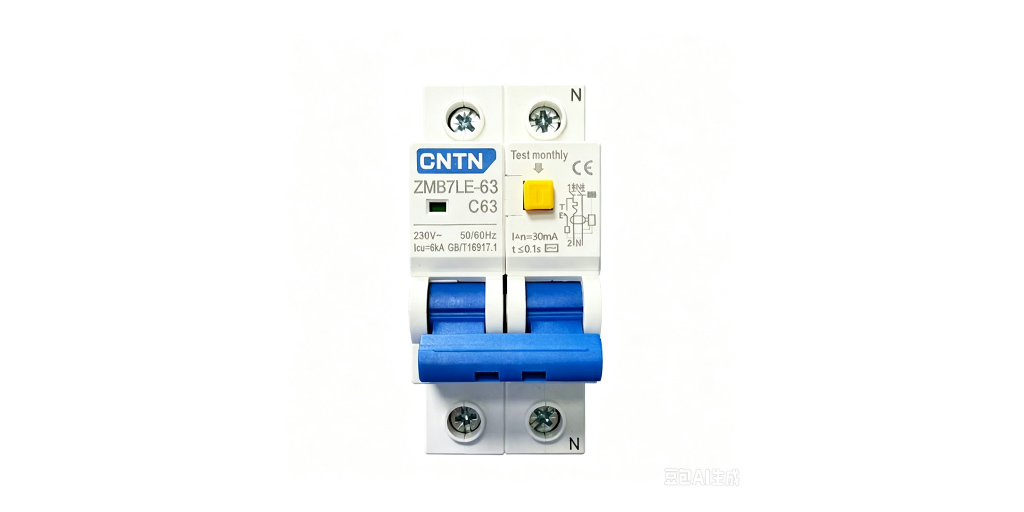
What Is an RCBO?
An RCBO (Residual Current operated circuit-Breaker with Overcurrent protection) combines multiple protection functions within one device
An RCBO can provide:
- Overload protection
- Short-circuit protection
- Residual current protection
This combination allows individual circuits to receive both overcurrent and residual current protection without necessarily requiring separate MCB and RCCB devices for each circuit.
Does an RCBO Have a Breaking Capacity?
Yes. RCBOs have approved short circuit breaking capability because they contain overcurrent protection.
This specific value varies depending on the RCBO. It is advisable for customers to check the manufacturers’ datasheets as it would be misleading to think that all RCBOs have the same kA rating.
RCBO Breaking Capacity Ratings
The usual ratings for RCBOs are 6 kA and 10 kA, although other ratings may be possible depending on the manufacturer and type of equipment being used.
It is important that the chosen rating be compared with the prospective short-circuit current at the installation point.
There are other parameters to consider, including the sensitivity of residual current, rated current, voltage, poles, and tripping characteristics.
Why RCBO Breaking Capacity Matters
RCBOs are more relevant in cases where each circuit requires its own protection.
They are normally used in residential and commercial distribution boards when fault isolation at the circuit level is desired.
For critical circuits, the use of RCBOs that provide both residual and overcurrent protection will ease the protection design.
It is also important to select RCBOs with enough breaking capacity.
RCCB Breaking Capacity: An Important Difference
What Is an RCCB?
A Residual Current operated Circuit-Breaker (RCCB) is mainly designed to detect residual currents and disconnect the circuit when the leakage current exceeds the pre-defined threshold value.
RCCBs provide residual current protection and minimize electric shock and earth-leakage hazards. But, RCCBs are basically different from MCBs because they do not provide overcurrent protection.
Does an RCCB Provide Short Circuit Protection?
An RCCB does not have any inherent overcurrent or short-circuit capabilities.
It becomes vital for selecting protection equipment. An RCCB requires proper overcurrent protection upstream, such as MCB or MCCB according to the system design.
Thus, it would be wrong to think that RCCB ratings are similar to the short circuit breaking capability of MCB or RCBO.
RCCB and Short Circuit Withstand Capability
RCCB is mainly designed for residual current, while MCB and RCBO protect overcurrents.
RCCB will have short circuit withstanding or conditional short circuit ratings.
The ratings define the fault levels which the RCCB can tolerate when the upstream protection device works properly.
The coordination of the protection system will depend on coordination between the RCCB and the upstream MCB or MCCB.
MCB vs RCBO vs RCCB: Breaking Capacity Compared
The key distinction is that MCBs and RCBOs are overcurrent protective devices with specified short-circuit interruption capability, while a standard RCCB primarily provides residual current protection.
| Feature | MCB | RCBO | RCCB |
|---|---|---|---|
Overload Protection |
Yes |
Yes |
NO |
Short Circuit Protection |
Yes |
Yes |
NO |
Residual Current Protection |
No |
Yes |
Yes |
Breaking Capacity |
Yes |
Yes |
Different rating concept |
Earth Leakage Protection |
No |
Yes |
Yes |
Individual Circuit Protection |
Yes |
Yes |
Usually requires upstream protection |
Typical Application |
Individual circuits |
Individual protected circuits |
Residual/leakage protection |
Breaking Capacity vs Rated Current: What Is The Difference?
These two specifications describe completely different characteristics of a protective device.
| Specification | What It Indicates |
|---|---|
Rated Current |
Normal current the device can carry under specified conditions |
Breaking Capacity |
Fault current the device can interrupt under specified conditions |
Residual Current Rating |
Residual current level associated with the device’s protection function |
Voltage Rating |
Maximum specified operating voltage |
Frequency |
Compatible system frequency |
Practical Example: 32A and 6 kA
Consider an MCB marked 32A, 6 kA.
Rating 32A is connected with the usual current that passes through the circuit, while the 6kA is connected with the ability of this equipment to interrupt short circuits.
This means that the rating of 32A does not show that the maximum current that this device can interrupt when short circuit occurs is only 32A.
Ultimate Breaking Capacity vs Service Breaking Capacity
For circuit breakers covered by standards that use these terms, Icu and Ics describe different aspects of short-circuit performance.
What Is Icu?
ICU or “ultimate short circuit breaking capacity” stands for the largest prospective short circuit current which the circuit breaker is designed to break during the test conditions.
It is an important limiting factor for the circuit breaker according to the standard used.
What Is Ics?
ICS, also known as service short-circuit breaking capacity, pertains to a circuit breaker’s capacity to interrupt certain short-circuit currents while retaining certain service features after the prescribed test process.
This concept is very important especially when it comes to reliability after fault interruption.
Icu vs Ics
| Parameter | Icu | Ics |
|---|---|---|
Meaning |
Ultimate breaking capacity |
Service breaking capacity |
Purpose |
Maximum tested fault interruption capability |
Indicates service-level fault interruption capability |
Importance |
mportant for maximum fault conditions |
Important for continued operational performance |
Note: Icu and Ics terminology and testing requirements depend on the relevant product standard.
They should not automatically be applied to every type of circuit breaker in the same way.
What Factors Determine The Required Breaking Capacity?
Breaking capacity selection should be done using a scientific technique rather than just depending on the amperage of the device.
Step 1: Determine the Prospective Short Circuit Current
Determine or calculate the prospective short circuit current at the point of installation of the protection equipment.
This is the main reference used when determining the desired breaking capacity.
Step 2: Check the Installation Voltage
Verify that the voltage level of the system is matched by the voltage rating of the protective device.
The voltage levels can influence the performance of the device.
Step 3: Identify the Device Type
Decide if the application needs MCBs, RCBOs, RCCBs, MCCBs, or any other form of protection device.
Different devices perform various forms of protection.
Step 4: Check the Required kA Rating
Compare the prospective fault current to the device’s short-circuit rating. The selected device should be appropriate for the fault level of the installation.
Step 5: Consider Upstream Protection
Coordinate operation with any protection equipment installed upstream.
This is especially critical where RCCBs rely upon upstream overcurrent protection.
Step 6: Verify Applicable Standards
Determine the relevant product standard for the chosen device and its use. Device types have separate standards.
Step 7: Confirm Manufacturer Specifications
Lastly, check the technical specification of the manufacturer. Determine the breaking capacity, voltage, current, poles, coordination and other necessary parameters.
How To Select The Right Breaking Capacity For Different Applications
Residential Buildings
MCBs, RCBOs, and RCCBs are installed in residences, according to the protective scheme involved. The breaking capacity should still be determined according to the prospective fault current, and not on some predetermined value.
Commercial Buildings
Businesses may have bigger electrical systems and higher fault currents. The prospective short circuit current needs to be determined by the designer.
Industrial Facilities
The power system might have higher capacity transformers, motors, generators, and distribution equipment. Calculations for these circuits will need to be done accurately.
The circuit breakers may have higher ratings, but the right value needs to be determined through analysis.
Distribution Panels
Attention must be paid to distribution panels since the position of the distribution panel in the electrical system will influence the fault current that may pass through it.
Solar and Renewable Energy Systems
Solar systems demand attention to both AC and DC circuits. The ratings of protective devices need to be appropriate in regard to the type of circuit, voltage, current, fault scenario, and circuit arrangement.
The breaking ability in AC and DC cannot be considered the same. Specifications and standards need to be verified in each case
Common Mistakes When Selecting Circuit Breaker Breaking Capacity
1. Choosing Only by Ampere Rating
Choosing the breaker only based on its ampere rating does not consider the prospective short circuit current. The two specifications are different.
1. Choosing Only by Ampere Rating
Choosing the breaker only based on its ampere rating does not consider the prospective short circuit current. The two specifications are different.
2. Ignoring Prospective Short Circuit Current
It becomes impossible to ascertain the appropriateness of the selected protective device without evaluating the fault current available.
3. Treating RCCB as a Short Circuit Breaker
It should be noted that conventional RCCB does not offer any overcurrent or short circuit protection.
4. Selecting an Unsuitable kA Rating
The interruption ability of the device is not enough to interrupt the fault current effectively; the kA rating needs to be verified for the fault level of the installation.
5. Ignoring Coordination Requirements
Protection equipment should work together harmoniously. Malcoordination would lead to unnecessary tripping or lack of protection.
6. Checking the Wrong Product Standard
Protective devices are rated against different standards. Consumers are advised to check the particular standard against the particular protective device being used.
7. Using Generic Specifications Without Manufacturer Verification
Technical data may differ between manufacturers and models. Always consult the technical manual for your specific device.
Buying Guide: How To Choose MCB, RCBO, or RCCB
Follow these eight steps when selecting a protection device:
- Identify the protection requirement– Determine whether you need overload, short-circuit, residual current, or combined protection.
- Determine rated current– Select the appropriate current rating for the circuit and connected load.
- Calculate prospective fault current– Establish the expected short-circuit current at the installation point.
- Select suitable breaking capacity– Ensure the device’s specified capability is suitable for the calculated fault level.
- Check voltage and frequency– Confirm compatibility with the electrical system.
- Verify pole configuration– Select the appropriate number of poles for the circuit arrangement.
- Check certification and standards– Confirm compliance with the applicable product and market requirements.
- Confirm manufacturer test data– Review technical documentation, ratings, and coordination information before purchasing.
Standards And Technical Specifications To Check
The applicable standard depends on the device type, application, and market.
- IEC 60898-1– Applies to certain circuit-breakers for household and similar installations, subject to its scope and conditions.
- IEC 60947-2– Covers circuit-breakers within the scope of low-voltage switchgear and controlgear.
- IEC 61008-1– Covers RCCBs without integral overcurrent protection, within its applicable scope.
- IEC 61009-1– Covers RCBOs with integral overcurrent protection, within its applicable scope.
Buyers should not select a product based solely on a standard number printed in marketing material. The complete product specification, intended application, testing requirements, and local regulatory requirements should also be verified.
Final Thoughts
Breaking capacity is an important factor in selecting circuit breakers, although it is not rated current.
MCBs and RCBOs offer protection against overcurrent with certain short-circuit breaking capacities, while RCCBs mainly offer residual current protection.
Choose the appropriate type of circuit breaker based on the following criteria.
For buyers looking for reliable circuit protection products, working with CNTN Electric can simplify product selection and sourcing.
Zhejiang CNTN Electric Co., Ltd. is a professional manufacturer of MCBs, MCCBs, RCBOs, residual current circuit breakers, and other electrical protection products. You can contact with our team right now, we will respond you as soon as possible.
FAQs
What is breaking capacity in a circuit breaker?
The breaking capacity refers to the highest specified prospective fault current that can be interrupted by a particular circuit breaker safely.
What does 6 kA breaking capacity mean?
The rating of 6 kA is the maximum prospective fault current that can be interrupted by the equipment under the prescribed test conditions.
Is higher breaking capacity always better?
Certainly not always. What is important is that the breaking capacity must be correct for the prospective fault current.
What is the breaking capacity of an MCB?
MCB has a defined value for short circuit interrupting capability which is usually expressed in terms of kA.
Does an RCBO have breaking capacity?
Yes. Since an RCBO is equipped with overcurrent protection, it has a certain short circuit-breaking capacity as per its relevant product standard.
Does an RCCB provide short circuit protection?
The conventional RCCB does not offer overcurrent or short-circuit protection. It usually needs proper upstream MCB or MCCB protection.
What is the difference between Icu and Ics?
Icu refers to the ultimate short circuit breaking capacity whereas Ics refers to the service short circuit breaking capacity.
How do I choose the correct breaking capacity?
Compute the short circuit current that is expected, then determine the appropriate equipment to be used.